When you have to make it memorable….

Lately, I’ve had the opportunity to fly a number of times. During the short flight from London to Toronto, the flight attendant stands in the aisle and completes the demonstration. On larger aircraft the safety video plays on either individual screens or larger ones which descend from the ceiling of the plane.  As a frequent flyer, I’ll admit that I watch half-heartedly, anticipating the seatbelt demonstration, the oxygen mask order of application, the lighted aisle way and identification of the nearest exits.

A few weeks ago, I was on a Delta flight to Ft. Lauderdale and as we were about to take off, the obligatory safety video started to play. But this video was different…. The airline, in their infinite wisdom (knowing that most of us tune out instead of tuning in during the demonstration) created and showed a video that was not only informative, but humorous.

According to the YouTube video, “Safety information is information that no one should miss, even if they’ve heard it a dozen times. So to help encourage even the most frequent of frequent fliers to pay attention we’re constantly adding fresh scenes and moments of fun. It’s part of Delta’s commitment to making every part of our passengers’ flight a memorable one.”

I started to reflect on that concept for teaching and learning.  How do we take the everyday and ordinary and effectively weave in humour in order to make it more memorable for our students?

For those of us whose audience is educators, do we make a concerted effort to include humour as an effective presentation tool?

As with all presentation tools, one must use caution.  Here are a few reminders about including humour:

1)     Make it relevant to the topic and tastefully placed within the presentation

2)     As with everything, rehearse it

3)     Make it personal, so it will come across as authentic and appropriate

4)     Don’t let the humour overshadow the message

5)     Make it brief and meaningful

william-arthur-ward-writer-quote-a-well-developed-sense-of-humor-is


Angels Among Us

“I believe there are angels among us. Sent down to us from somewhere up above”. That is a line from one of my favourite Alabama songs.

Macaroni, ceramic, crystal, silver and gold ~ Christmas angels come in all shapes and sizes.  But what about those angels who surround us throughout the rest of the year?

I finally watched one of the classic Christmas movies, last night.  Believe it or not, I have never watched, “It’s a Wonderful Life” from beginning to end.  I have known the basic premise and seen various scenes, but this is the first time that I’ve enjoyed the whole movie from beginning to end.

And as Clarence earned his wings and the final bells rang, I started to think about all of angels we have in our world of education.  Those people who work tirelessly behind the scenes to empower our teachers who inspire our students. Those people who remind us that even though our work is challenging it is worth it.images (1)

There are those parents who share how much our students enjoy coming to school and what a difference we are making in their lives. Those few words of encouragement go such a long way.

Our crossing guards and bus drivers who brave all kinds of weather to ensure that our students arrive safely in our schools.

All of the dedicated, caring front office staff, who greet everyone who enters the office with a smile and a determination to provide them with whatever they need from a registration form to a bandage and everything in between.

Our custodial staff who know the importance of a clean and safe school. How a school looks speaks volumes about pride and a sense of belonging.

Then there are our colleagues who seem to know when we need a helping a hand, a great idea to inspire our students, an offer to do a supervision duty for us or a much needed smile as we rush through the hallway.

I wonder if without those angels, we may find ourselves on a figurative ledge feeling the enormity of our responsibility of educating this generation of learners.

I have been very blessed in my career to be surrounded by angels and I hope that I have taken every opportunity afforded to me to be an angel in the lives of others.

Who are the angels in your life?

images

Come write with me…..

The gift of a book

2014-12-13_1711As educators, we all know the power of placing a book into the hands of a child and watching them sparkle with delight as they crack the spine for the very first time. There is nothing more rewarding.  For those children in our personal lives, we’ve gladly given them books for birthdays, Easter, Christmas and “just because”.  But for many of the children who we support in our schools, home libraries are a luxury that many families can not afford.

This year, one of the initiatives that our Literacy Coordinators are involved with includes supporting a select number of students in 10 of our most needy schools.  We are working with entire school teams to enhance teacher capacity in the area of supporting struggling readers, scaffolding the learning that is happening in terms of guided reading instruction and assessment strategies and supporting the discussions that are taking place at School Literacy Team meetings, where a full school approach to knowing, supporting and celebrating the accomplishments of these students is at the forefront of what is happening.

In the summer, children were given the opportunity to choose a handful of books to have for their very own as well as pictures books for others in their lives to share with them.  Parents were provided with suggestions and strategies to support home reading programs and they expressed their gratitude for the gifts.

We are now in the process of repeating the book celebration and providing those same students with more books to add to their home libraries.

School teams have planned wonderful celebrations to celebrate the gains that these students have already made in their reading ability. They are celebrating the wonderful teachers who have taken on this challenge of reflecting on their practice and exploring new strategies to meet the needs of all of their students. Parents are being celebrating for supporting home reading programs.

Today, a number of the involved teachers forwarded pictures to our team. The students were smiling with pride and gratitude. Parents were gracious and thankful. Teachers were beaming with pride, knowing that they have made a difference.

We will all sleep well tonight knowing that we’ve placed one of the greatest gifts into the hands of some very deserving children and that the intangible gift of a school’s “love and dedication” will continue to encompass these “babies” as they gain more and more confidence in their abilities and see themselves as capable readers.

23140cdd3d5a4e0cc45880562d19250a

Down the Rabbit Hole

“I can’t go back to yesterday because I was a different person then.”
― Lewis CarrollAlice in Wonderland


bringittogetherpromoLast week I had the pleasure of attending and presenting at the Educational Computing Organization of Ontario’s Bring it All Together14 Conference.  The line-up of keynote speakers was extraordinary with each presenter sharing their own perspective on technology, pedagogy, connection, creation and communication. Throughout the three days, participants were provided with a wide selection of sessions to attend.  Presenters were well versed and obviously very passionate about the benefits of effectively using technology to engage students, staff and the broader educational community.  The cheers, claps and head nods reinforced the messages that those of us in attendance believe to be true.

As I moved from session to session, tweeting out thoughts, ideas and strategies which resonated with me, I couldn’t help but wonder, “Why don’t more of our colleagues ‘get it’?”

I often hear people say that they don’t have the time to be more “connected” or that they are self-proclaimed luddites when it comes to using technology.  We would never accept that excuse from our students, if we asked them to learn something new or something that was going to create the conditions for them to be more prepared to meet the future and yet somehow we feel, as educators, it’s acceptable.

During a lunch break, David Fife and I met and chatted with Mark Carbone the Chief Information Officer for the Waterloo Region District School Board Ontario, Canada and our conversation turned to this very topic. I equated the world of technology to Wonderland and shared that it’s such an exciting place to be, I can’t imagine not sharing it with all my friends.

alice

In revisiting Alice in Wonderland, I found this quote, “I can’t go back to yesterday because I was a different person then”.   And just like Alice, I can’t imagine going back to a time when I didn’t have a connected Professional Learning Network.  I learn so much from educators around the world who teach me, challenge me and motivate me to stay current and contemporary.


If you haven’t ventured down the rabbit hole yet, take a page from Alice and take the plunge.  You’ll find it an incredible place to be.

The GPS of Leadership

GPSI love many components of my job as the Languages Learning Supervisor, but some of my most thought-provoking challenges emerge during my interactions with Literacy Coordinators as we develop sessions to share with the staff within Thames Valley.

One of our Professional Learning Series is entitled, “Journeys into Literacy” and in an effort to provide consistency and visual appeal, we use many graphics related to travel.

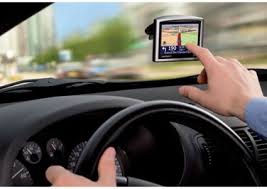
Last week, during one of our sessions, we used a picture of a GPS to depict the role of an administrator as they facilitate learning conversations with their school teams.

One of the first things we do when using a GPS is to input our destination.  School leaders, through their work with their school teams determine where they need their schools to go. They look at their data and choose their most urgent student need.  That student need becomes the basis for their school improvement plan.   They are working towards arriving at that goal.

Knowing where you’re going is the first step.

Each GPS has a feature which allows you to choose how you’re going to reach your destination. The scenic route, the most direct, the fastest etc. are all options.  When leading school teams, leaders need to know which parts of the journey they will need to slow down on and which parts their school teams already have a good handle on and therefore, less time is needed.  If their school team needs more time on developing a collaborative culture, then it’s time to slow down and take the scenic route. If the school team has a deep understanding about the power of positive relationships, they the lead can cruise on by.images (1)

Knowing how to get there is the second step.

Another feature on the GPS allows the user to zoom out or zoom in.  As leaders, there will be times that you will need to have a bird’s eye view of the school ~ what is consistently happening (or in some cases not happening) throughout the whole school. Those are the times you are zooming out.   But then there will be times that you’ll need to zoom in and focus on specific divisions, departments, grade levels.

Knowing which view (big or small) is the third step.

The final feature is the volume control. When we are driving on a well-known route, we do not need the volume turned on.  It can even lead to frustration, at times.  But when we are traveling in an unknown or challenging area, we need the volume to assist us in making those correct turns.  As a leader, when we are facilitating the learning conversation, there are times when our voice needs to be heard, to ensure the right direction is being adhered to.  But there are other times, when we need to be on “mute” and our teachers need to be leading the learning.

Knowing when to lead the learning is the fourth step.

images (8)

The GPS analogy met our needs and we were glad that we had embedded it in the conversation.

When thinking about your leadership, which graphic would you chose?

Come write with me….

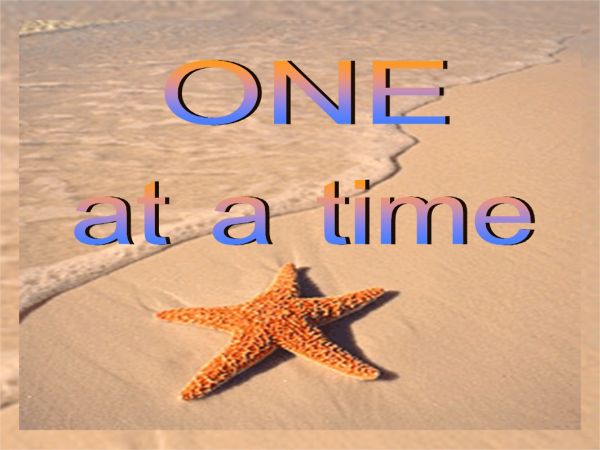
One at a Time

one_at_a_time-LRGThere are days when the magnitude and far reaching responsibility of my role as the board’s Languages Learning Supervisor suddenly hits me.  My job is to lead and work alongside of our Learning Coordinators, Coaches and Teachers on Special Assignment to ensure that all of our students become literate.   Yet, we know that we are far from reaching that goal.  Many of our students continue to struggle to communicate their thoughts and ideas effectively.  Many of our students continue to avoid reading because they have not yet gained the confidence to read independently.  Many of our educators continue to look for new and innovative ways to engage students in literacy, as they still feel that they are not meeting the needs of all of their students.

So…. Where does one begin?

Earlier this week, on my drive into work, I stumbled upon a favourite CD ~ Garth Brooks’ Greatest Hits and as soon as I heard, “The Change” it immediately reminded me of something that was shared at my very first meeting as a new administrator.   Our Executive Superintendent, at the time, was doing his best to calm our nerves as we were about to embark on this journey and in doing so, he read the poem, The Starfish about a man who, seeing a shoreline full of starfish ~ destined to die ~ begins to throw them back, one at a time, knowing that he can’t save them all.   The final line of the poem is “It made a difference for that one”.  It reminds us that we can make a difference, one child at a time, one teacher at a time.

In searching for images to enhance this post, I found so many that I decided to compile them into a video and add the soundtrack from “The Change”.


Our job is to continue to move forward,  to embark on new journeys, to try new strategies, to continue to teach all of our students to read, write and communicate ~ one at a time.  And in making a difference for “one”,  we will ultimately make a difference for all.

Who did you make a difference for today?

Come write with me….


Beauty vs Brains

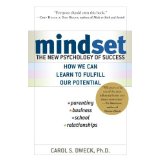
“Some of us are trained in this mindset from an early age” from Carol Dweck’s Mindsetsmindset

I can clearly recall one day, when I was about 13 and visiting my maternal grandmother. It was in the summer and I was sharing my report card. As the conversation continued, she started reflecting on her children (2 daughters) and grandchildren (3 granddaughters and 1 grandson).  My aunt, who was 5’10” and a stunning beauty was a photographer’s dream and spent a great deal of her youth modeling.  She was extremely artistic and had a great eye for colour and design. She went on to marry a handsome Maltese sailor and needless to say their daughters inherited olive skin, perfect smiles and flawless complexions.  My mom is about 5’4” and in her youth she sported Shirley Temple black curls, dark brown eyes, she excelled at athletics and was academically strong.  She was poised to become a Phys. Ed. Teacher, but fate had other plans and I’m so proud of how extremely well both her and my dad have done.  Teenage parents who went on to successful careers and strong family values.

Now back to that day with my grandmother…. With firm conviction she shared that girls where born with either beauty or brains.  She was thrilled that my cousins had inherited their mother’s beauty and how proud she was of me, because I was the one with the brains.

I recall, as the words left her lips, I quickly caught my reflection in the lovely ornate mirror above the fireplace and convinced myself that she must be right.  I had my report card (filled with A’s) and the certificate for the General Proficiency Award to confirm that I had the “brains” and my gangling 5’9” frame was something less than ideal.

It’s been over 35 years since I heard that comment and yet as soon as I read the above quote in Dweck’s book, the memory and the insecurities attached to that conversation are as fresh as the day my grandmother shared her views.  In a split second, I knew that I had been “labelled” in the eyes of someone who had known me from birth ~ my future had been predetermined.   I know that my grandmother didn’t mean any harm. In fact it was just the opposite ~ in her mind, she was giving me a high compliment.  After all beauty diminishes with age, yet brains will take you further, right??images (7)

As a parent, I continually reinforce with my own daughter that she has been blessed with beauty, brains, brawn and above all the ability to work hard to be anything that will bring her love and joy!

This little walk down memory has reinforced the power of words and labels when we are working with our students and our staff. Even with the best of intentions, our words may have a lasting impact.  We need to be sure that we are not limiting their ability or more importantly how they see themselves.

How do you empower students to see themselves as capable?  How do you create a Growth-Mindset in both yourself and your students?

Come write with me…..

When is something worth writing about?


download (1)

The idea for my first blog came from a candlelight service at church, one Christmas Eve.  I poured and poured over the words/graphics/ punctuality and finally hit the publish button ~ confident that no one, other than a few close friends would ever find it.   It was at least another month before I created my next post for my blog and I’m pretty positive that I only wrote something because a friend was in the background reminding me, challenging and supporting me to get something posted.  I can recall asking myself,   “Is this topic important to anyone? Does this make sense? Will anyone else care what I’m writing about? Why the heck did I start this blog?  Will this be another passing fade? Will it have an impact on my ability to lead a school community?”

Four years later, I have an Evernote file filled with ideas for blogs, it takes me twice as long as it should to read a professional resource as I fill the margins and the front and back blank pages with blog ideas and I capture picture quotes, on a daily basis, which spark an idea. My newest challenge isn’t coming up with ideas, it’s having the dedication to sit down at the computer and expand those ideas into a post.

images

Just today I was reading a text on Instructional Coaches and one of the concepts reminded me of a scene from  Working Girl, where Melanie Griffiths needed to prove where her idea for a corporate merger came from.  In her innocence, she shared that it was a combination of an announcement in the Society pages and an article in a financial magazine.  In the margin I wrote “Where do our best ideas come from?”

The other day, I shared with a colleague that a tweet I had tweeted at an International Conference had been captured in print and was used within the article about the success of the conference.  He asked, “Was it an original idea?” Initially my bubble was burst!  The tweet was a combination of two ideas which, in my mind, needed to be connected into one thought.  To me, it had meaning!  So, in my mind ~ worth tweeting!   And really, that is all that counts, when you make the step towards making your thinking visible, by using the written word.  If it resonates with you, then put it out there. It allows others to see what is important to you.  Of course, they will judge you, some will agree, some will disagree. But in the end your own thinking will be pushed!

IRA

For those of you who are ready to take that first step…..Tweet something that is meaningful to you, reply to a Tweet,  post it on Facebook, write a blog, comment on someone else’s blog, write an article for your favourite magazine, write about education, write about your kids, write about your travels, write about your pets…. Just write something!


Embrace the Nike philosophy ~ Just Do It!

Where do some of your best ideas come from?

Come write with me……..

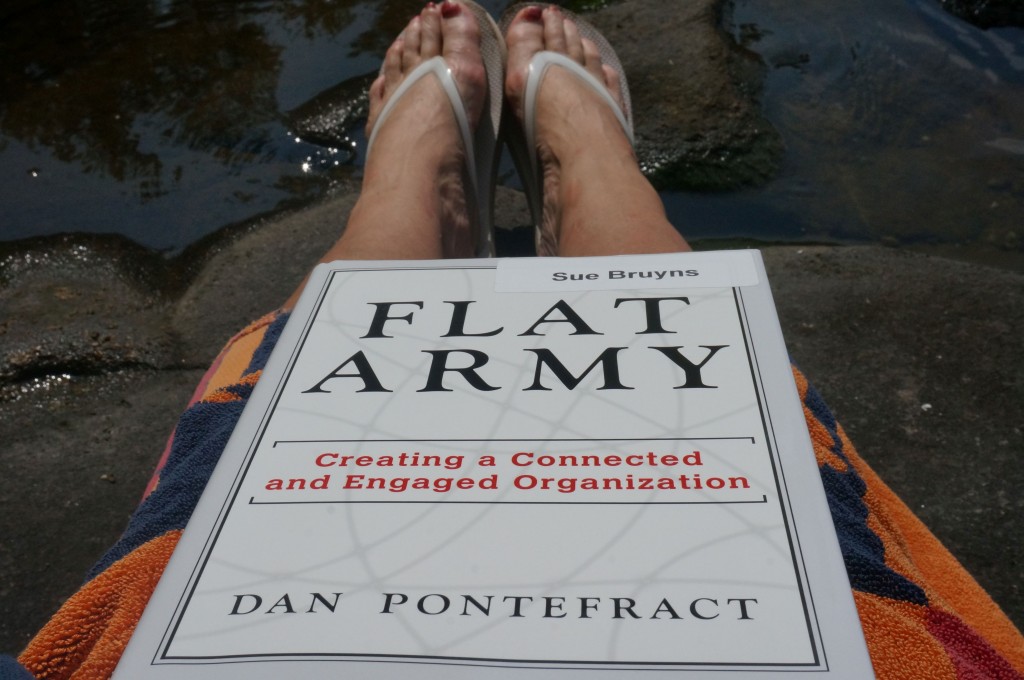
Flat Army

For the past few years, each June, administrators in our board have been given a professional resource (or two) to enjoy over the summer. The two most recent books were Stratosphere by Fullan and Intentional Interruption by Katz.  I found both resources to be informative and impactful on my work within my new portfolio. In fact I shared my thoughts on them in past posts on this blog.

So this June, when Flat Army was placed on my desk, for my summer reading pleasure, I anxiously awaited for my alone time at the cottage and quickly found a quiet spot away from the bustle of the fishing expeditions, the concentration of the jigsaw completion and the aimless raft floating.  Within the first few lines, my pen was poised and I was filling the margin with asterisks, question marks, and personal connections.  I was emphatically underlining quotes and comments which resonated with me.

DSC01215

Pontefract effectively paints a picture of an organization where ideas flow seamlessly throughout the ranks paying no heed to position, paycheck or past experience.  He challenges our status quo notion of the best and brightest ideas being brought forward by those in the greatest power positions.  Instead of a system based on hierarchy, he poses the challenge of a “Wirearchy ~ a dynamic two way flow of power and authority based on knowledge, trust, credibility and a focus on results enabled by interconnected people and technology”.

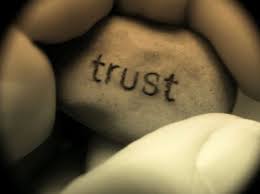
Within that list of criteria, which is most important to you?  For me, the concept of trust is significant. As a leader I want those whom I have the opportunity to work with to know that I trust them.  I trust them to do their job, to be responsible to themselves and to those they work with. I trust them to extend their own learning and to bring new ideas forward.  When they do, we’ll try them.  If they work, Great, if not ~ what did we learn for the next time?

A skill that I have learned is to always question myself about my intention versus what others eventually see as my actions. Trusting my team is my intention, but does it come across with my actions?  I guess I better find out!

download (1)

Unfortunately, not all employees feel trusted. Pontefract shares, “We’ve learned to become helpless. We’ve become numb to our bosses who don’t care. We’re ambivalent to leadership that is hierarchical and closed minded.  We’ve become blind to exclusivity and too paralysed to suggest being included.”

It is sad to think how many innovative, exciting, trendsetting ideas sat dormant, because someone was “too paralyzed” to share.

“Social media flattens hierarchy” is not a quote from the book, but a connected idea that was shared at an Edcamp a few weeks ago.  How true!!   Today, anyone has access to the thoughts, ideas and newest research from the greatest minds all over the world.  With the quick swipe of a finger or a click of a mouse and the ability to critically analyze the validity of that information, we can process and implement what we read immediately.  And just as our teachers need to come to grips with the fact that they are no longer the “only imparter of knowledge”, leaders need to appreciate that the next best idea may come from an employee who has read a book, read a Tweet, read a blog or had a deep discussion with another.   In order for that employee to feel comfortable sharing that idea, the culture must be created for that to happen without any repercussions (real or perceived).   No more admonishments for not following the hierarchical procedure of asking questions or sharing information. No more threats of being sent to a less desirable department/school location.  No more closed communication communities.  Information should flow seamlessly throughout an organization. 

images (1)

Open source, open doors, open minds and open hearts will lead to an innovative, healthy organization.

No longer can we expect our leaders to be on the “cutting edge” of every new technology, new leadership concept or the latest trending idea, as information is coming at all of us at a tremendous speed and volume.  But we should be able to expect that they are there, right alongside of us, learning.  Trying new technologies, seeking feedback on their ideas and thoughts in online social forums, sharing their own learning challenges and successes.

Isn’t that what we want for today’s learners?  All learners ~ students, educators and those leading educational organizations.

Today’s leaders need to be engaged in “Social Learning ~ serendipitous learning that happens through social exchanges that results in a knowledge negotiation”.  And those social exchanges should be happening with people at all levels of the organization and worldwide via the Interent.  I would be concerned if leaders only spent time with each other ~ only learning from each other.  Pontefract shares pictures and stories of Mayor Bloomberg out and about within the office.  Sitting with others ~ not holding “court” in his office.

As leaders, how often do we immerse ourselves in the very work that we are leading?  Do we leave it to others to present the final product to us or do we roll up our sleeves and experience it first hand? Experience true learning complete with the frustrations and the excitement?

I wonder if we created a more connected and engaged organization where our leaders didn’t feel the burden of having to always be the “one” with the answer,  would that allow them more time in the field where they, too, could be learning?

Needless to say, this latest resource did not disappoint!  I was thankful that I had applied a layer of sunscreen that day, as my “I’ll only be a few minutes”, turned into an uninterrupted reading of Flat Army cover to cover ~ margins filled, highlights throughout and more questions than answers.  And here I am, weeks later, questions still resonating, tweets with the hashtag “flatarmy” still being posted and looking forward to chatting with other colleagues who have read the resource.

There were many take away quotes from this book.  But for the purpose of this post, the one I will leave my readers with is this one, “I will practice caring, sharing and daring ~ caring for others, sharing what I know and daring to try new things”

As a leader, do you consider yourself connected and open to the ideas of others?  Would others consider you connected and open to their ideas?

Come write with me…..
Whose Hand Do You Choose?

From Laura Ingalls in her one room school house on Little House on the Prairie to Horshack’s “ Oooh, ooh ooh” in Mr. Kotter’s images70’s classroom to Rachel Berry in Glee,  we have images of students raising their hands to share their knowledge.  We see it every day in classes all over the world.

As a classroom teacher, I’ll admit that when it came time to choose which student to share the answer, it was usually a student whom I assumed had the correct answer. Back then, my thinking was that the other students needed to know that their answer was also correct or that they had not quite figured out the right answer.  I’m also assuming that I, as the teacher, wanted the affirmation that what I had taught had been internalized and “learned” by the student who was sharing the correct answer.

download

After reading Carol Dweck’s Mindset ~ The New Psychology of Success,  I’m positive that if I were to return to a classroom,  my philosophy of “the right answer” would be dramatically different and I publically apologize to my former students.  If I had known better, I would have done better (Maya Angelou)

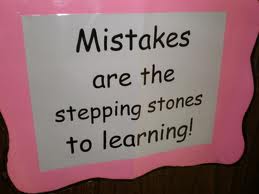
Dweck asks a poignant question ~ “Isn’t that what school is for, to teach?  They’re there to learn how to do these things, not because they already know everything”.  By asking the student with the right answer, I wasn’t really teaching those who needed me, was I?   Back then, mistakes were something to be avoided.  The smart students got smarter, raised their hands more and received better marks on their report cards. For those students who were struggling, we worked in small groups, where I provided them with “modified” work which they could complete, instead of having them share their answers with the whole group and taking that opportunity for all of us to learn together.

As today’s educators, we need to instill a growth-mindset in our students, so that they view mistakes as an opportunity for feedback and learning.

If we do that then, we’ll be supporting students “whose primary goal is to expand their knowledge and their ways of thinking and investigating the world. They will not see grades as an end in themselves but as a means to continue to grow”.

We need to create learning environments where learning is truly the work that is happening.  Not environments where teachers provide easy tasks, record who gets it and who doesn’t and then move on.   Classrooms need to be places where standards are high, mistakes are a part of the culture and both educators and students are learning.

How do you handle “mistakes” in your classroom?   Is learning truly at the heart of what you value in your classroom?  If so, how do you make that visible for your students, your colleagues and the rest of your school community?

images (1)

Come write with me….