
It was an early start, as my admin partner and I dove into timetabling. A challenging task for a school with 34 current classes and the knowledge that we’ll undoubtedly be reorganizing in the fall as welcome new families ~ not to mention the significant unknowns of what “re-entry” to schools in a time of COVID-19 will look like by the time September rolls around. We know that we will be revamping these timetables even before the first day of school of September. But at least we have a bit of roadmap and the conversation about how best to support our students is always a welcomed one, as we worked our way through the task.
I’ve always loved the challenge of timetabling as it is the first step in creating positive learning environments for our students. We take into consideration common planning time, traffic patterns to maximize student interaction and minimize educator travel time and the best times of the day for learners to be active, to name but a few. We know that we need to stay within the “sandbox” of contractual number of minutes of preparation for educators, but the rest of the job can be completed with an innovative lens to making the minutes match the desired outcome.
Partway through the morning, we took a break as the site manager for portables met me at the school to look at where our 4 new portables were going to be installed and to discuss moving our current long jump pit (commonly known as our sandbox, based on the raised sides and common gathering place for our youngest students) in order to make space for one of the new portables. I had invited a few staff members, our Phys. Ed specialty teachers, to join us for the conversation. After all, they are the experts on this. It is their voice that matters. They had done some research at other schools and knew how to make the most of the conversation and share a site location and the details for the new long jump pit. Their ideas were so welcomed and ones that I would never have considered. I’m so thankful for their input.
As I returned to the timetabling task, with my admin partner, I received an email about another spring task that we’re currently involved with, which initially surprised me and then frustrated me. The details are not as important (nor for sharing publicly) as the analogy to the sandbox. With each leadership task that we undertake, we are provided with the parameters (the edges of the sandbox) ~ whether it is procedural language in a Board Policy /Procedure or a Ministry PPM or the language within the contracts for our multiple unions. Over the years, I’ve become adept at knowing those contracts (such as who you can interview, how many minutes of preparation time, etc.) knowing where to find and how to share Board Policies/Procedures (having had the pleasure of writing some of them) and the importance of the connection of Ministry PPMs to the work that we do at a Board and school level.
But where I find myself getting frustrated is when you play within the sandbox and try to be innovative in your practice (with the intent of building collective educator efficacy and improving student learning) and the sides of the sandbox shrink.
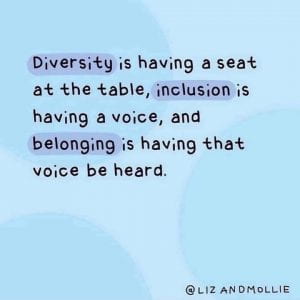 Throughout my career, I’ve been so fortunate to be asked to support a number of colleagues as they transition from classroom educator to vice principal or from vice principal to principal. I love the opportunity to highlight their leadership skills and provide specific examples of how they have positively impacted their school cultures. The conversation easily flows from one question to the next with great details and examples until we get to the “diversity/inclusion” question. Each time it is asked (and I always know when it’s coming) I pause as I find myself having to dig a bit deeper to provide concrete examples ~ mostly because the candidates that I’m supporting create diverse/inclusive cultures as a matter of their everyday interactions with their staff, students and broader school community. For me, it is more of a mindset than an actionable objective.
 This morning, during my daily social media scroll I came across an article discussing the Prime Minister of New Zealand, Jacinda Ardern’s possible solution to economic recovery from COVID-19. Ardern first came to my attention with her swift ban on semi-automatic guns in the wake of the Christchurch massacre. I was immediately impressed and continued to watch her leadership moves.
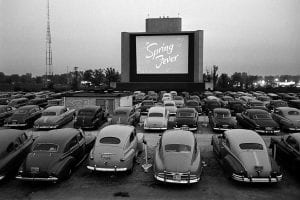
 Do you ever wonder what triggers memories? I have no doubt that somewhere in the land of Google, one would find endless links to such research.
 I’m intentionally crafting and publishing today’s post early this morning as I’m anticipating that once 1:00 pm rolls around and the Minister of Education makes his announcement about the remainder of the school year, regardless of the message, my mind will begin to shift in a number of directions. If the message is that we’re maintaining Learn at Home for the next 6 weeks, how do we continue to engage families and maintain positivity among our staff? What will it look like as we distribute the personal belongings for over 750 students? But most importantly closure ~ not the physical closure of the school, but the emotional closure that happens at the end of a school year. For us, our tradition has been that at 3:29 p.m., on the P.A. system, we play “
 As I was scrolling through a number of online articles, today, I came across this one
 Like so many of you, I watched former
  Reflected on my pre-pandemic calendar for tonight was our annual OPC Spring Dinner. Historically, an evening to come together with colleagues, one last time before the end of the school year, to share funny anecdotes and upcoming summer plans. It is also our opportunity to celebrate and recognize colleagues who have decided to take the next step in their journey and venture into retirement. For the past few years, the evening has been a bittersweet one, as many of those who are retiring are my contemporaries. We started teaching or we entered into the wild world of administration at the same time. I start to envision the fall when we come together for our first meeting of the new school year and know that there will be fewer and fewer familiar faces. It’s a magical time in one’s career when you know all of the retirees and some of them you’ve had the pleasure of working closely with.
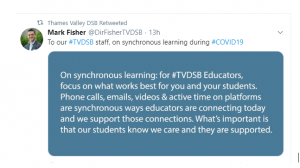 As I sat with my pen poised, ready to take notes during our weekly check in with our Director and Senior Team, my mind was racing as to what our school board’s next steps were going to be in reaction to the Minister of Education’s announcement, late last Friday afternoon. Stephen Lecce took to the airwaves and shared that it was always the Ministry’s expectation that teachers were providing synchronous (in real time) learning opportunities. I found myself going back to mid-March, when the Ministry modeled the first Learn at Home learning experiences. At no time did the Ministry offer synchronous opportunities. As I recall their offering was a list of websites. I couldn’t help but wonder, if it was “always” an expectation that such synchronous learning was an expectation, then why didn’t the Ministry model how they wanted that to look when we first started down this path.
 When you research the 5 Most Helpful Tips to Prepare for a Job Interview, I would venture to guess that at no point in reading that list you would find tips such as: